Unlabeled flag
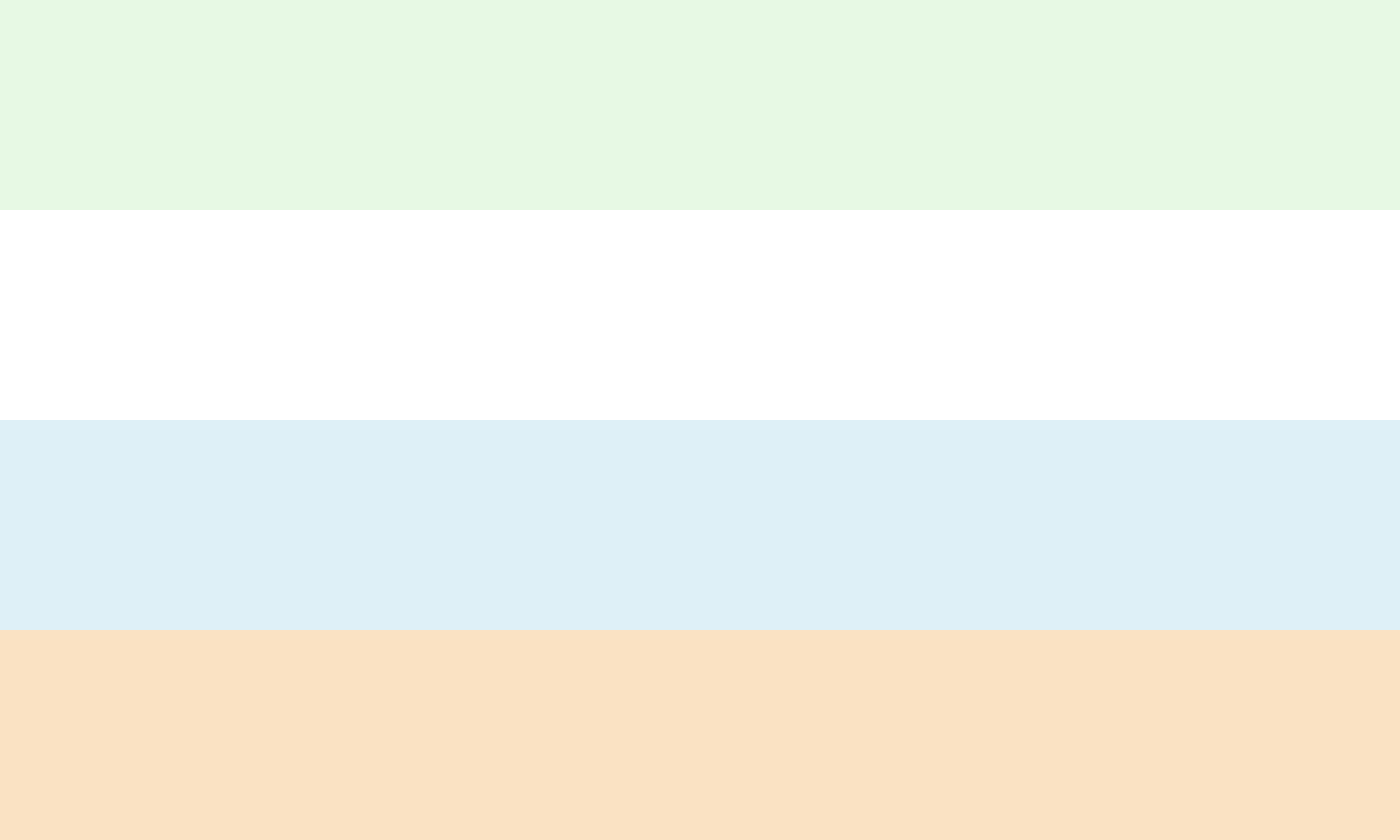
Pale green, white, pale blue and pale orange, for people who choose not to label their gender or sexuality.
What the colours mean
- Pale green Freedom.
- White Understanding.
- Pale blue Acceptance.
- Pale orange Flexibility.
Colour codes #E7F9E4#FFFFFF#DEF0F7#FAE2C3
Download the flag PNG WebP SVG
Four designs, and the one you will usually see
There is no single unlabeled flag. We found four designs, made between 2020 and 2022 by people posting online, and none has any official status. Nobody counts how often a flag is used, so saying which one is most common is a judgement, and here is the evidence behind ours.
The pale four-stripe flag shown at the top is the oldest we could date: in December 2020 a tweet already presented it as "the unlabelled pride flag", adding that it was "not very well known but it exists". It is the design filed as the Unlabeled Pride Flag on Wikimedia Commons, where it is the only flag in the category for unlabeled sexual orientation. It is also the one in the Kreative Vexillo flag library, which added it in April 2023 in a batch of pride flags spotted at a convention vendor's booth, a sign that it was being made as a physical flag. Two community wikis show it first. Neither that Commons category nor the Vexillo library includes the other three, and the Human Rights Campaign's flag guide lists none of the four.
The four-stripe flag (2020)
The earliest explanation we found is an explainer page archived in December 2020. It says the flag "was created on twitter by @lwtsroses"; later wikis spell the name lwtroses. Neither account exists today, so the original post cannot be checked, and one wiki says plainly that it is unclear who created the flag. Treat the designer as unconfirmed.
The same page gives the meanings shown above: green for freedom, white for understanding, blue for acceptance and orange for flexibility. A later version of the page adds that the reasons behind the colour choices are not known.
We found no colour codes from the designer. The codes used here, #E7F9E4, #FFFFFF, #DEF0F7 and #FAE2C3, are the ones published by Wikimedia Commons and the Kreative Vexillo library, and they are close to the colours of the image shared in 2020.
The No Label Pride Flag (2021)
On 16 January 2021 the Reddit user Employee_472 posted a flag "for LGBT people who don't label their gender/sexuality" in several LGBTQ+ and flag communities. The image names it the No Label Pride Flag.
Its centre is a symbol built like the peace sign: it combines the flag semaphore signals for N, for no, and L, for label, and the designer notes that the letters LGBTQ can also, loosely, be read in it. The symbol can be used on its own, in any colour.
The designer published three colour codes and chose to leave the meanings open, since "no label" is such an umbrella term. The violet, #6F00FF, was picked for its boldness. It mixes violet and blue, which stand for harmony and spirit on the original rainbow flag, and here it can also stand for androgyny, for attraction to different genders, or for anything else you read in it. Black, #000000, and white, #FFFFFF, give contrast and can represent a lack or an abundance of gender or attraction. The rainbow strip at the fly, whose colour codes were not given, keeps the flag recognisable when it hangs limp and represents a connection to the LGBTQ+ community; the designer suggested it could be swapped for another version of the pride flag, such as the Philadelphia flag, which adds black and brown stripes.
Several people in the Reddit thread asked whether a flag is not just another label. The designer replied that they had been getting that response, and that the aim was to raise awareness of the option of not choosing a label.
A chevron design (2021)
A third design pairs five horizontal stripes with a rainbow triangle at the hoist. The LGBTQIA+ Wiki credits it to the Reddit user NeonGhoti on 6 October 2021, but it links to no original post and we could not find one, so that attribution is unconfirmed.
The meanings the wiki gives: the rainbow for a connection to the LGBTQ+ community, dark blue for masculinity, blue for unity and community, light lavender for androgyny and the LGBTQ+ spectrums, pink for love and romance, and dark pink for femininity. We found no published colour codes.
The six-stripe design by Ghosturtle (2022)
The fourth design was made on 6 July 2022 by Ghosturtle, a user of the LGBTQIA+ community wiki on Fandom, who presented it on an explainer page about the term that he made. It has six stripes, each explained by the designer: dark blue for life beyond labels, white for flexibility and infinite possibility, peach for acceptance and understanding, pink for love and joy, purple for freedom, and plum for community.
Some of the reasoning is worth knowing. The dark blue is close to black, a colour often used for an absence, but deliberately not black, because lacking labels does not mean lacking an identity. The purple is close to lavender, a colour linked to queer liberation, but deliberately not lavender, because not every unlabeled person counts themselves part of the LGBTQIA+ community.
How each design is laid out
**Four-stripe flag.** Proportions 3:5. Four horizontal stripes of equal height, from top to bottom: pale green #E7F9E4, white #FFFFFF, pale blue #DEF0F7, pale orange #FAE2C3. All four are very pale, so on a white page the flag needs a thin outline.
**No Label Pride Flag.** Proportions 3:5, measured on the designer's image. Along its length the flag has three vertical fields: violet #6F00FF over the first 90.2%, then a white stripe 2.3% of the length, then at the fly a rainbow strip 7.5% of the length, divided into six horizontal bands of equal height (red, orange, yellow, green, blue, violet; measured on the image as #F00000, #FF8000, #FFFF00, #007940, #4040FF, #A000C0). A black disc with a white ring is centred on the violet field, not on the whole flag: its centre sits at 45% of the length and half the height, the ring's outer diameter is 71% of the flag's height and the ring is 6% of the height thick. Inside the disc are two white strokes as thick as the ring: one crosses the whole disc at 45 degrees from lower left to upper right, the other runs from the centre to the ring at the lower right, also at 45 degrees.
**Chevron design.** The only image we found is a compressed 16:9 file, so the colours are approximate values measured from it. Five horizontal stripes of equal height, from top to bottom: dark blue about #1D1B80, light blue #6DCDF3, light lavender #EEE2F3, pink #E88AC8, dark pink #A3337F. Over them, a triangle whose base is the whole hoist edge and whose point touches the middle of the height at about 43% of the length, split into six vertical bands of equal width: red, orange, yellow, green, blue and purple, about #CC2C1E, #EA8C34, #F3E64C, #377B30, #1D49E8 and #6D1D82.
**Six-stripe design.** Proportions 3:5. Six horizontal stripes of equal height, from top to bottom: dark blue, white, peach, pink, purple and plum. The designer published no codes; measured on his image they are #2A004A, #FFFFFF, #FFDAD9, #FE93F1, #A330FF and #8C1358.
What unlabeled means
Being unlabeled means choosing not to use a specific label for your gender, your sexuality or both, even when one might fit. Some unlabeled people use a broad word such as trans or queer and stop there; others use no word at all. It is not the same as questioning: plenty of unlabeled people are not looking for a label and do not want one suggested. As the explainer page puts it, a lack of labels does not necessarily mean a lack of identity.
According to the same page, the word was once used by lesbians who identified as neither butch nor femme, before its meaning widened. It sits at the opposite end from microlabels, and both are fine.
Questions people ask
What are the colours of the unlabeled flag?
The most widely used unlabeled flag has four horizontal stripes: pale green, white, pale blue and pale orange.
What do the unlabeled flag colours mean?
Green for freedom, white for understanding, blue for acceptance and orange for flexibility. Why those colours were chosen is not documented.
Who created the unlabeled flag?
Nobody can say for certain. The four-stripe flag was credited in 2020 to a Twitter account that no longer exists. The other designs were made by the Reddit user Employee_472 in 2021, by an unconfirmed designer in 2021, and by Ghosturtle in 2022.
Is there more than one unlabeled flag?
Yes. We found four designs from 2020 to 2022. The pale four-stripe flag is the one you will see most often.
If unlabeled means no label, why is there a flag?
A flag can stand for a community rather than a label. The designer of the 2021 flag said the point was to make people aware that not choosing a label is an option.