Non-binary flag
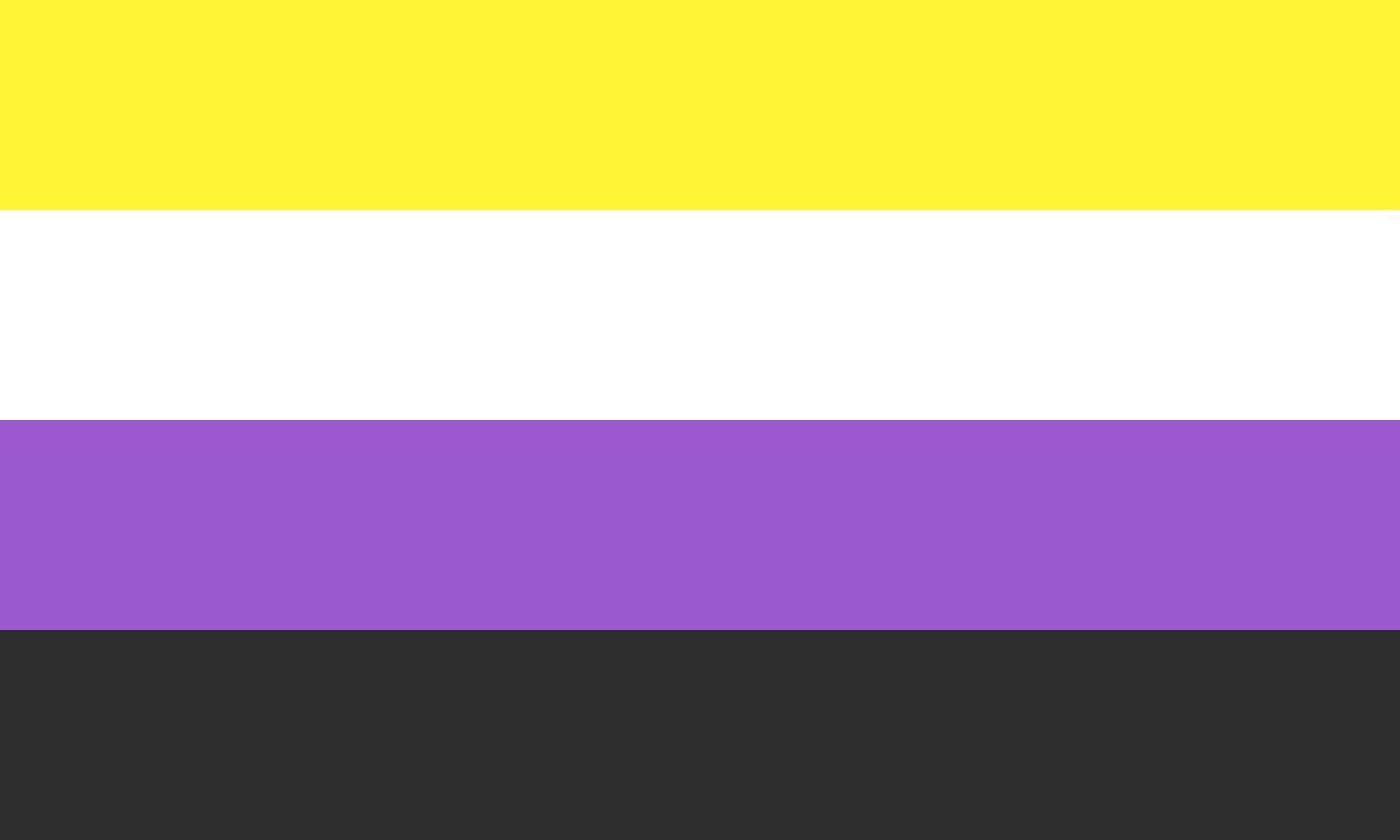
Yellow, white, purple and black: a flag for people whose gender is outside the binary.
What the colours mean
- Yellow Being outside the binary: yellow is often used to mark something as its own.
- White People with many or all genders: white is the presence of all colours.
- Purple The fluidity and multiplicity of gender, and genders between or including female and male.
- Black People who are agender or without gender: black is the absence of colour.
Colour codes #FFF433#FFFFFF#9B59D0#2D2D2D
Download the flag PNG WebP SVG
Where it comes from
The non-binary flag was designed by Kye Rowan, who posted it on Tumblr on 17 February 2014 in answer to a call for a flag for non-binary people. Rowan presented several variations, and the stripe order that became standard is yellow, white, purple and black. The meanings above are Rowan's own.
Why a flag alongside the genderqueer flag
The genderqueer flag, designed by Marilyn Roxie in 2011, already existed. Rowan explained that not all non-binary people identify as genderqueer, and that using a flag so closely tied to that word pushed them under a label they did not want.
Rowan was explicit that the new flag was meant to sit alongside the genderqueer flag, not to replace it. Both are still in use.
The white stripe
Rowan later specified a very pale cream, known as cosmic latte (#FFF8E7), for the white stripe. The version with pure white is still widely used.
Using it
Rowan released the flag under a Creative Commons licence: anyone may use it, as long as they do not claim to have designed it. Many non-binary people fly it together with the transgender flag, which covers everyone under the trans umbrella, non-binary people included.
Questions people ask
What are the colours of the non-binary flag?
Yellow, white, purple and black, in four horizontal stripes from top to bottom.
Who designed the non-binary flag?
Kye Rowan, who posted it in February 2014.
What do the non-binary flag colours mean?
Yellow for being outside the binary, white for people with many or all genders, purple for fluid genders and genders between or including female and male, and black for people without gender.
Is the non-binary flag the same as the genderqueer flag?
No. The genderqueer flag is lavender, white and green and dates from 2011. The non-binary flag was designed in 2014 to sit alongside it, not to replace it.
Can anyone use the non-binary flag?
Yes. Its designer released it under a Creative Commons licence, which only asks that nobody claim to have designed it.