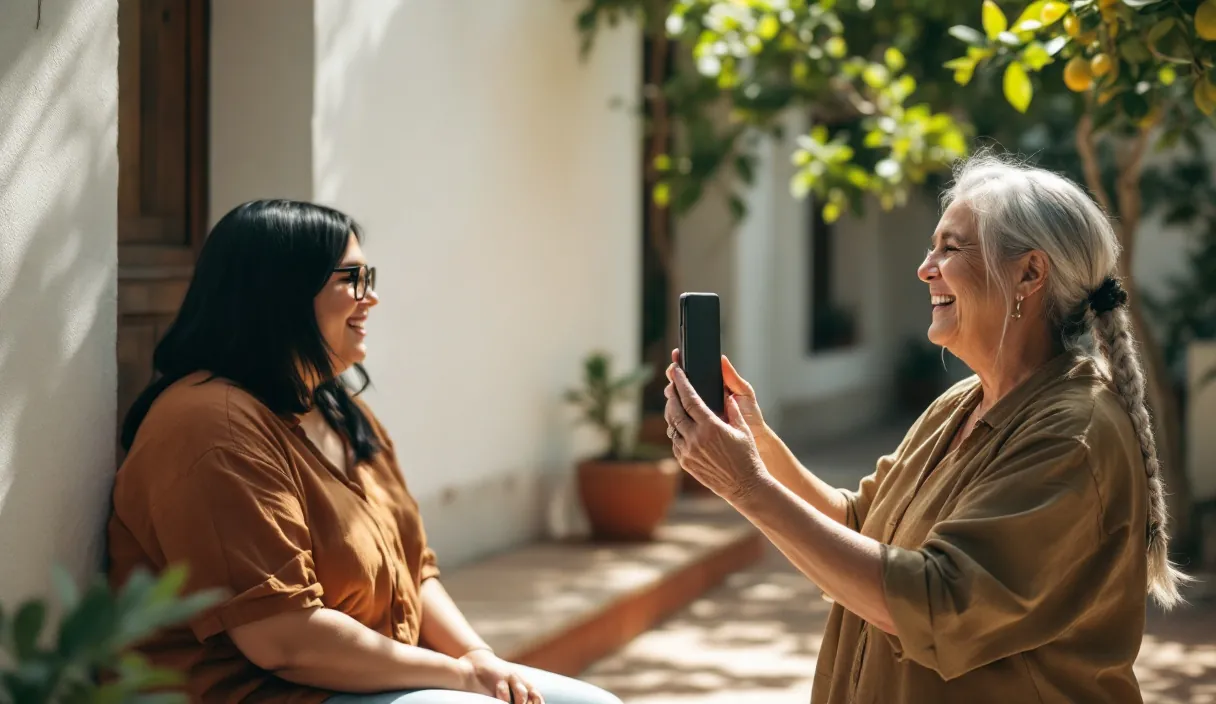
The dating profile photos that work best are recent, clear and yours: at least one where your face is easy to see, a few that show what you actually do, and none that make people guess which person you are. For trans and non-binary people the same photos carry extra decisions: whether they say you are trans, whether they show your history, what they give away about where you live, and who gets to see them. This guide covers what helps people connect, and what to keep private.
What helps people connect
Choosing is harder than it looks. In a 2024 survey of 7,000 single app users aged 18 to 25 in seven countries, commissioned by Tinder, 52 per cent said it was hard to pick a profile photo. The advice the big apps give is consistent, and none of it needs a photographer:
- A solo first photo. Bumble's guide says the very first picture should be just you, and Tinder's dating expert suggests one group photo at most, so nobody has to work out which person you are.
- At least one clear view of your face. Hinge's rules ask for one photo that clearly shows your face; Bumble's ask for one that shows only you and your full face. Bumble's guide adds that people should be able to see your eyes.
- Good light. Tinder suggests natural light, such as a shaded spot on a sunny day, and a lens wiped clean before you start.
- Variety. Tinder's expert lists four kinds: a portrait, something you love doing, a photo with people, and a candid one.
- Recent, and recognisably you. Bumble's guide suggests photos from the last year, ideally the last six months, and Hinge's rules say outdated photos go against its values.
More photos help too, within reason. Bumble says its data shows that three or more photos increase your chance of matching, and Tinder says men who show their face in more than one photo are 71 per cent more likely to match with women. Those are the apps' own figures, Tinder's is explicitly about men matching with women, and none was measured on trans people. The direction is the same everywhere, though: people want to see who they are talking to. For how many photos to post and what to write next to them, see what to put on a dating profile.
Photos that feel like you
No photo proves anything about your gender, and a profile is not a passing test. A more useful question is whether you recognise yourself. Pick the pictures where you feel like you, the ones with a bit of gender euphoria in them, rather than the ones you think a stranger will read a certain way.
Trans people use their photos in very different ways. Researchers at Northwestern University interviewed 20 trans dating app users in the United States for a study published in 2019. One participant who did not identify as either man or woman paired a picture in makeup and a skirt with one in a beard, tank top and cargo shorts, looking for someone who was fine with their look changing. A trans woman chose photos that showed what she might look like on any given day, not only those where her hair and makeup were done a certain way, and described that as a matter of honesty. Others kept their trans status out of the profile altogether and raised it in conversation.
All of those are legitimate. When Bumble's guide tells you to look basically the same in every photo, the worry behind it is catfishing: the photos should be recent and clearly of the same person. The same face in a skirt and in cargo shorts meets that standard.
Old photos, edited photos and AI
Whether to include photos from before transition is your call, and people make it in both directions. In the same study, one trans man put pre-transition pictures on his OkCupid profile on purpose, so that nobody could miss that he was trans. For someone who is stealth, the same pictures are exactly what gives the history away, and dating while stealth covers that side. Hinge does not allow photos of minors at all, including younger photos of the user, so childhood pictures are not an option there whatever you decide.
Recent photos also matter for verification. Checks usually compare a live selfie with the photos on your profile, so a profile built on older pictures can fail; our guide to dating app verification explains where this trips up trans people in particular.
Editing has limits. Bumble's guidelines do not allow photos so distorted, or so heavy with digital effects, that it cannot be clearly determined you are the person in them, and in July 2024 Bumble added a way to report profiles using AI-generated photos or videos.
AI is arriving on the other side too, as tools that pick photos for you. Tinder's Photo Selector compares your face with the photos in your camera roll and suggests some; Tinder says this all happens on your phone and that it only receives the photos you choose to upload. In February 2026 TechCrunch reported that Tinder was testing a feature in Australia that asks for access to your camera roll, and that Facebook Dating offers AI edits of photos you have not shared yet. If your camera roll holds pictures you would never post, from before transition or of friends who are not out, give such tools partial access only, and look carefully at what they suggest.
What your background gives away
The most revealing detail in a photo is often behind you. In 2019, Tokyo police arrested a man suspected of stalking and assaulting a 20-year-old pop idol. According to Japanese media, he had worked out which train station she used from scenery reflected in her eyes in high-resolution photos she posted, and then where she lived from other pictures she shared. That is an extreme case. The everyday version is simpler: a street sign, your front door, the view from your window, a workplace logo or lanyard, a number plate, a local landmark.
Australia's online safety regulator, the eSafety Commissioner, advises keeping your address, workplace and location off your dating profile, and not posting pictures of your children, even ones you are in. Before you upload anything, look at each photo the way a stranger would, zoom in on the background, and crop or retake anything that places you.
Other people in your photos count too. A picture with friends also tells strangers who your friends are. Ask before you use one, and take extra care if a friend is trans and not out to everyone: being recognised on someone else's dating profile can out them.
The location hidden inside the file
A photo can also carry its location invisibly. Apple explains that when the Camera app has access to Location Services, the coordinates of the place a photo was taken are embedded in the file, and that people you share it with may be able to see them. Menu names shift a little between versions, but the steps are short:
- iPhone. To share a photo without its location, tap Options in the share sheet and turn off Location. To remove it from a photo, open the photo's information, then Adjust Location and No Location. To stop it at the source, go to Settings, Privacy & Security, Location Services, Camera, and choose Never.
- Android. Google says a location added by your camera cannot be removed in Google Photos, and that the original location travels with a photo shared outside it. The dependable route is to switch off location in your camera app's settings, which vary by manufacturer, before you take photos for your profile.
An app may strip this data when you upload, but you cannot check that from outside, so remove it yourself. The other invisible trail is the picture itself: a photo you have already posted on social media can lead back to that account through a reverse image search. eSafety advises against reusing them for that reason, and pictures that exist nowhere else are the safer choice.
Who gets to see which photo
Unless an app says otherwise, assume every profile photo can be seen by anyone your profile is shown to. A few apps let you narrow that:
- Private photos. Feeld lets members on its paid Majestic plan make photos visible to their connections only. Its help page adds a catch: if the membership lapses or is cancelled, those photos become visible to all members.
- Albums you share and unshare. On Grindr, an album is a private set of up to 10 photos and one video, shared through a chat. You can stop sharing at any time without the other person being notified, but deleting the album message from the chat does not unshare it.
- Private profiles. eSafety notes that some platforms let you stay hidden until you match, often as a paid feature.
On T4TSpace, a dating app by and for trans and non-binary people, every account is checked by a person, and the main photo has to show your face; only verified members can see it, as our verification page explains.
None of these controls survives a screenshot, and Grindr itself warns that people can capture private content with a second device. Where being trans or queer is dangerous, that matters most. In a 2018 study of app users in Egypt, Lebanon and Iran, the free expression organisation Article 19 found that screenshots of profiles were widespread and used for blackmail, violence or arrest. Some users showed only their face or only their body to protect themselves, and the report points out that authorities can use either against them. If no photo of you is safe to post, deciding not to use a dating app for now is a legitimate choice, and how to hide dating apps on your phone covers the wider risks.
Finally, you do not owe anyone more photos. A new match who pushes for body pictures, or intimate ones, is telling you something about why they are there, and how to spot a fake profile explains why an early request for intimate photos is often the setup for extortion.
Wren · Editor
Wren is the name the T4TSpace blog is published under. The posts are written by the small team that builds the app, and signed with one name so the voice stays the same from one piece to the next.