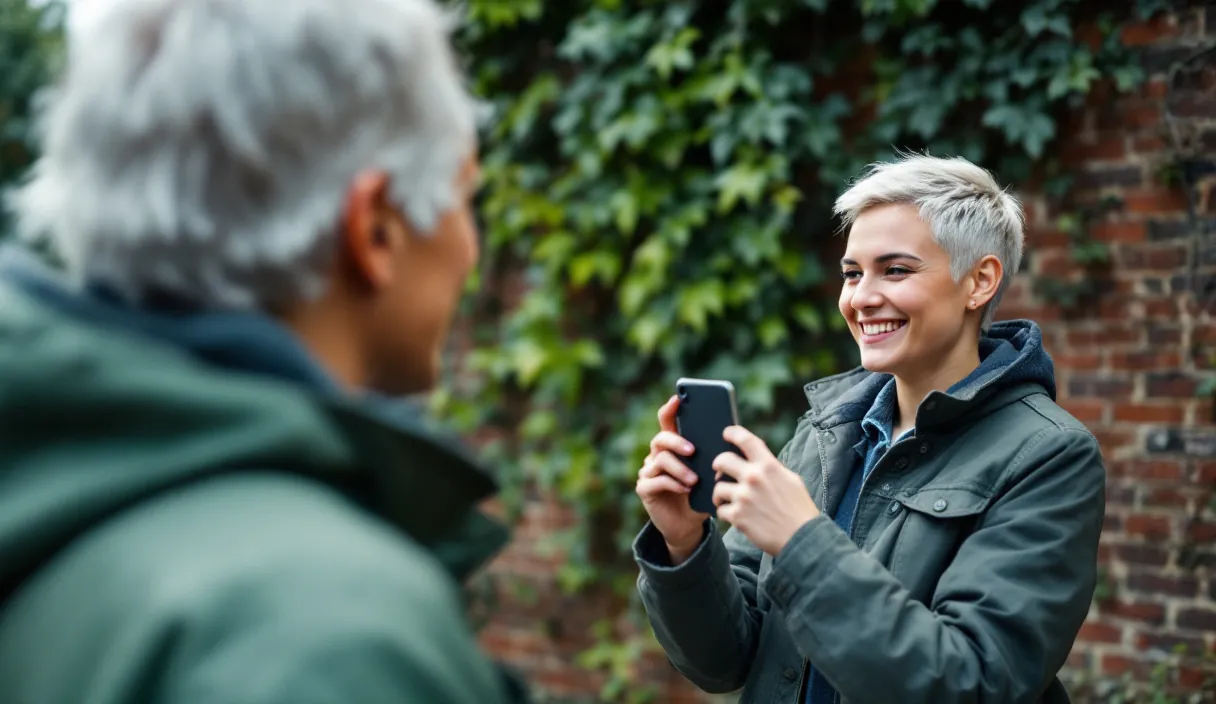
Dating app verification usually means a selfie or a short video, sometimes an ID document, compared with the photos on a profile to show that a real person who looks like those photos is behind the account. It does not prove who someone is, what they want, or that they are safe to meet, and Tinder and Hinge say so in their own help pages. For trans people it can also go wrong in particular ways: photos taken at different points in a transition, documents that carry a name you no longer use, and reports from people who did not expect to see you.
What a verified badge actually checks
Most of the big apps run some version of the same test, with different machinery behind it:
- Tinder started testing photo verification in January 2020 with guided selfies compared to profile pictures. Today its help centre describes an optional video selfie with a liveness check, to show that the photos on your profile look like you.
- Bumble asks for a selfie copying a pose it chooses. It says verification is mandatory in the United States and optional elsewhere unless Bumble asks for it, that it uses a mix of automated and human review, and that you get three attempts.
- Hinge's Selfie Verification is a video selfie in two steps: a liveness check that a real person is filming, then facial recognition comparing the video with your profile photos. OkCupid describes the same two steps.
- HER asks for a selfie matching a randomised pose and says its team reviews every verification photo by hand, which can take 24 to 48 hours. A profile without a clear face photo is one of the main reasons its checks fail.
All of these answer one narrow question: does a live person who looks like these photos control this account? That question is worth answering, because it catches people using someone else's pictures. It is also the only question being answered.
Face checks, ID checks and age checks are spreading
Verification is moving from an optional badge to a condition of entry. In October 2025 Tinder announced Face Check, a video selfie required of all new users in seven countries and the state of California, which also detects the same face being used across several accounts. It became required for new users in the UK from 26 March 2026. Hinge runs its own Face Check in some regions and says that if you fail it, you cannot use Discover, send likes or use many of its core features until verification is complete.
ID checks go further. Tinder's ID and photo verification, offered to some people in selected markets, compares a government photo ID with a video selfie and your profile photos, and checks that the date of birth shows you are over 18 and matches your profile. Bumble offers a free ID badge in eleven countries, including the UK, France, Germany, Spain, Mexico and the United States, and says it uses the ID to check your age and your photo.
Age checks are the third layer. The UK government says the Online Safety Act applies to dating services, including those based outside the UK. Grindr introduced age assurance in the UK in July 2025, later adding Australia and Brazil; Feeld asks members in the UK and Australia to confirm they are 18 or over by a live selfie or a mobile phone check; Hinge cites the UK, EU, Australian and Brazilian rules for its own age checks. Grindr says its check estimates age rather than recognising your face, and admits that the estimate can occasionally be wrong.
What no badge can tell you
A badge proves a face, not a motive. Someone who sees trans people as a category rather than as people can pass every one of these checks, because nothing in them looks at intentions, and a chaser using their own photos is, technically, verified. The same goes for someone hiding a relationship, or someone who is simply unkind.
The apps are clear about this in their small print, even when the marketing is warmer. Tinder's older safety centre page tells you that with a verified profile you can rest assured someone proved they are who they say they are. Its current help centre says photo verification does not guarantee the identity or safety of a particular user, and that ID verification does not guarantee the validity of the ID. Hinge uses almost the same words for both of its checks.
So verification is a filter, not a vetting. A short video call, a conversation that goes somewhere other than your body, and a first meeting somewhere public still do most of the work. How to spot a fake profile covers the checks that stay in your hands.
Where checks go wrong for trans people
Face matching assumes your face stays roughly the same. For many trans people it does not, and profile photos get updated as it changes. Hinge warns that changing your photos after verifying may cost you your verification, and Tinder can ask you to redo the check when it detects unusual activity. None of that is aimed at trans people, but an ordinary transition, with photos updated along the way, is exactly the kind of change it reacts to.
The clearest documented case comes from outside dating. In 2018 CNBC reported that trans Uber drivers were being suspended, temporarily or permanently, when a selfie check compared their face with the photo on file and found no match. One driver who had updated her photos through her transition was deactivated because a photo did not match her driving licence, and lost about three days of work before it was put right. We could not find a comparable case reported on a dating app, so treat this as a warning about the mechanism, not a measured rate.
Research points the same way, with an important caveat. A 2019 University of Colorado Boulder study of four commercial facial analysis services found trans men were wrongly identified as women up to 38% of the time, and that the services could not classify non-binary people at all, because they only knew two answers. That study tested software guessing gender, not the selfie matching dating apps use for verification. It is not a failure rate for your Tinder check, but it shows how easily face technology builds in assumptions about what a man or a woman looks like.
Reported for existing
Trans people can also lose access through other users rather than a failed selfie. In 2015 trans users on Tinder described being banned after other users reported them. Tinder said every banned account was assessed individually and that wrongful bans were reversed, including when trans users were reported without breaking any rules, and said at the time that its male or female settings led some users to report people who unexpectedly appeared in their recommendations. When Tinder widened its gender options in November 2016, NPR reported, it asked people who had been wrongfully removed after reports to get in touch for review.
Reports still trigger checks. Grindr's help centre says an account reported for suspected impersonation is suspended until the owner verifies it with a selfie, and that age checks can be triggered by reports. Hinge says its support team cannot manually verify a photo on your behalf.
If this happens to you, screenshot the ban or failure message, use the app's appeal route rather than opening a new account (Tinder's Face Check is built to spot the same face on several accounts), and keep your replies short and factual. You do not owe anyone an explanation of your body or your history to get your account back.
What happens to your face and your documents
Before you verify, read what is kept, because it varies a lot. Tinder says it does not keep your video selfie, but keeps the face map and face vector made from it for the life of your account, deleting them within 30 days of closure. Hinge's optional Selfie Verification deletes facial geometry within 24 hours but keeps three screenshots and the result for the life of the account, and says they may be used to train its trust and safety systems. Bumble says your verification selfie is stored with your other photos, without saying for how long. Grindr says the company that runs its age check does not keep your image or video.
ID checks keep more. Tinder says it retains the name on your ID for the life of the account, along with the photo from the ID and a redacted image of its front. Its help page does not say the name is compared with your profile or that the gender marker is read. But if your documents still show your deadname, that name sits in the app's records for as long as you keep the account, and you should know that before you upload anything. Tinder also says verification data may be shared between Match Group companies to make their services safer, for example to identify and ban accounts, so a ban on one app may not stay on that app.
In the European Union, the GDPR treats biometric data used to identify a person as a special category, which can only be processed under specific conditions such as explicit consent. Tinder and Hinge both say they process verification data with your consent, though Hinge notes the legal basis can change from one country to another. Where a check is optional, that consent is yours to refuse.
If a check keeps failing, and what to look for in an app
Practical fixes first. Make sure at least one profile photo is recent and shows your whole face clearly, film in good light, and skip filters; Hinge suggests a neutral expression. If you have used your attempts, contact support and ask for a review rather than trying again from a new account. And think before uploading an ID that does not match who you are now: an optional badge is rarely worth that trade.
When you compare apps, verification is worth four questions. Is it free, or a paid extra? Does a person look at it, or only software? What is kept afterwards, and for how long? And is it required of everyone, or a badge some people have and others do not? The trans dating apps compared sets out what each app advertises. At T4TSpace, a dating app by and for trans and non-binary people, every account is checked by a person, and our verification page explains what that check looks at.
Wren · Editor
Wren is the name the T4TSpace blog is published under. The posts are written by the small team that builds the app, and signed with one name so the voice stays the same from one piece to the next.