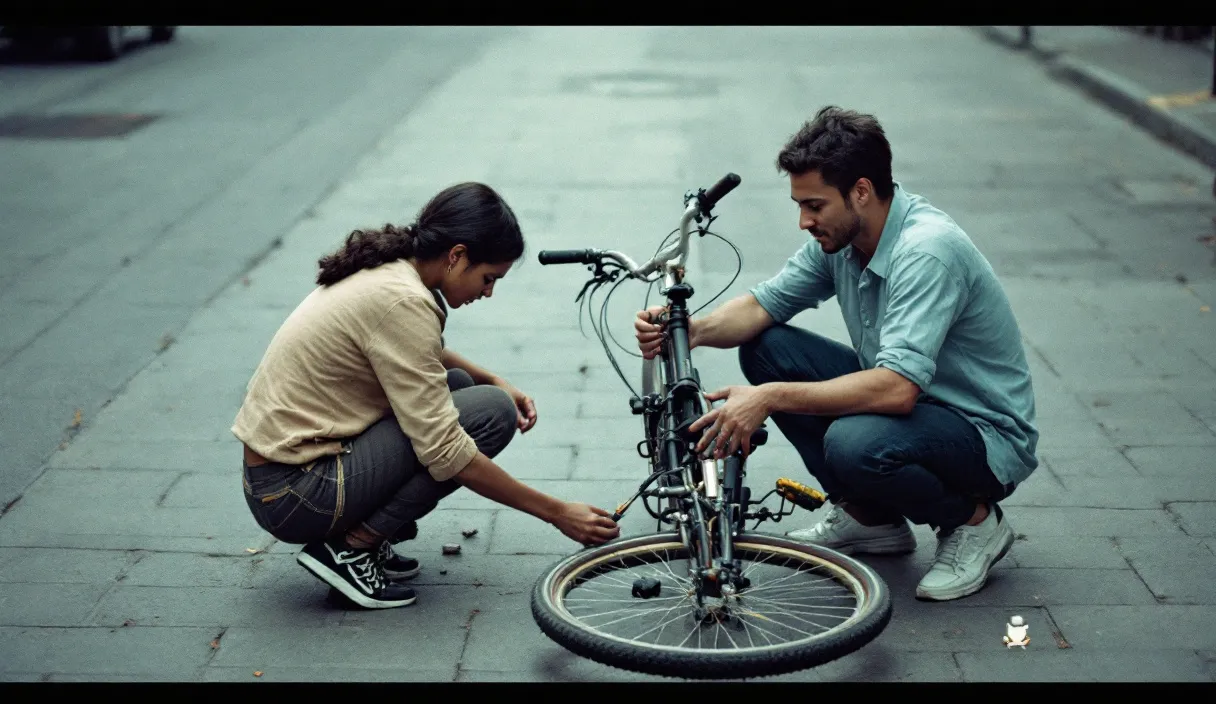
There is no such thing as a non-binary haircut, only cuts and the signals they send. Length, the sides and back, the fringe and where the volume sits all change how a cut is read, and you can set each one on purpose: towards masculine, towards feminine, or somewhere hard to place. This guide is for non-binary and transmasc people, and anyone looking for androgynous or gender-neutral haircuts. It covers those signals, cuts for straight, curly and coily hair with the upkeep each needs, and how to ask for one. The basic names of cuts are explained in androgynous style.
What makes a cut read one way or another
Hair is a large part of gender expression, the outward part other people use to guess at your gender. Barbers and stylists share conventions about what reads masculine or feminine. They are not rules about who may wear what, but knowing them means you can use them.
- The sides and back. Short, clipped sides with more length on top are one of the strongest masculine codes. A guide by the non-binary writer Charlie Lewis lists fades, squared-off edges and lines shaved into the hair among the features that make a cut read masculine, and notes that pairing long hair with an undercut or a fade does the same. Soft layers at the sides pull the other way.
- The neckline. One transmasc haircut guide lists a cleaner neckline among the things to ask for. A short, tidy nape reads sharper; hair falling onto the neck softens the view from behind.
- The fringe. A medically reviewed styling guide says side-swept or curtain fringes, and layers near the cheeks, soften a strong jawline. Hair pushed up and back does the opposite, and short sides with more length on top draw the eye to your bone structure.
- Volume around the face. Fullness at the cheeks can make a face look rounder. The same transmasc guide suggests cleaner sides and some height or texture on top for exactly that reason, so the overall shape does not look too round.
- Texture. That styling guide also points out that a style can mean different things on straight, wavy, curly, coily or locked hair. On Afro-textured hair, short fades and tapers can read strong, and a curly shag can move from strong to soft with a change of parting.
Ambiguity usually comes from mixing these on purpose: a sharp taper with a soft fringe, or a long shag with a clean neckline. Your face, your hair and your clothes shift the result too, which is why a photo never looks quite the same on you.
Whether you want to be read clearly or not at all is your decision. For some people, being read a particular way is about getting through the day safely, and passing is part of the calculation. For others the whole point is to be hard to place. Both are good reasons to choose a cut.
Cuts, what they do and what they ask of you
These are cuts people often ask for, with the signal each tends to send and the upkeep it needs. Names are used loosely: a barbering guide points out that what one shop calls a low fade, another calls a taper. Bring a picture as well as a name.
- Undercut. Long on top, with the back and sides clipped very short or shaved. It puts length and a strong masculine code on the same head, and how you wear the top changes the read. Leaving it takes months (see below).
- Curtain fringe. A long fringe parted in the middle or at the side. Curtained hair originally meant this fringe with short sides and back; on longer, layered hair it softens and frames the face. It suits curly, wavy and straight hair, though a curly fringe should not be cut too short. John Frieda's guide suggests a trim every three to four weeks.
- Shag and wolf cut. Layers at many lengths, full at the crown and thinner at the edges. The shag has been a unisex cut since the 1970s; the wolf cut, its 2020s variation, is shorter at the front in a way that recalls the mullet, and often has a fringe. Both look soft and undone. A salon guide calls the shag low-maintenance with a trim every few months, and hairdressers quoted by Stylist say the wolf cut works on every hair type.
- Mullet. Short at the front and sides, long at the back. i-D called 2020 the year of the mullet, and a taper fade on the sides has given the classic version a cleaner look.
- Pixie. Short at the back and sides, a little longer on top, with a very short fringe. It is short without the hard edges of a barbershop finish. It needs frequent trims: stylists quoted by Coveteur suggest every four to six weeks, or six to eight, and one London salon that specialises in Afro hair suggests every three to four weeks for a sharp shape.
- Crop with a taper. Short on top, with the back and sides tapered: the hair gets gradually shorter down towards the natural hairline, leaving some length at the sideburns and neckline. It reads tidy without being severe and grows out gently; one barbering guide gives a taper three to four weeks before the neckline needs cleaning up.
- Buzz cut. The same short length all over, done with clippers. It is low-maintenance day to day and makes the face look more defined, and it has become popular among women as well as men, sometimes worn as a protest against conventional standards of feminine beauty.
- Fades. A fade is a taper that goes down to the skin, so the hairline at the sides and back seems to disappear. It gives the sharpest contrast and one of the clearest masculine reads, and it has the shortest life: the same barbering guide says a fade loses its edges in about two to three weeks, and a skin fade sooner.
Curly, coily and Afro-textured hair
Most haircut guides are written with straight hair in mind. Curly and coily hair behaves differently, starting with shrinkage: as it dries it draws up, by anything from a couple of inches to more than half its length depending on the curl pattern, according to a salon that specialises in textured hair. That is why many curl specialists cut dry, and ask you to arrive with your hair clean, dry and styled the way you usually wear it.
It is also why your reference photos should show hair with a texture like yours.
- Teeny weeny afro (TWA). A very short, cropped afro, about two inches or less, often the cut people have after a big chop. The trade magazine Hairdressers Journal notes that a fade or an undercut can be added, with designs cut in.
- Curls on top, tapered or faded sides. Keeping the curl on top and cleaning up the sides is the textured version of the classic masculine shape. Ask for it as a curly crop, a curly undercut or a curly top fade, and say you want the curl pattern kept.
- Hi-top fade. Very short sides with the top grown tall and shaped. It defined a lot of late 1980s and early 1990s hip hop, and Grace Jones wore her own flat-top version on the cover of her 1980 album Warm Leatherette.
- Afros, twist-outs, twists and locs. The medically reviewed guide mentioned above says afros, twist-outs and braid-outs work in many ways, and that longer locs worn with curls or jewellery can feel soft or fluid.
Not every barber or stylist has been trained to cut textured hair. In the UK, the national standards for hairdressing were only updated to include Afro and textured hair in 2021, when the British Beauty Council said tens of thousands of hairdressers had no qualification in cutting and styling it. Asking how often someone cuts hair like yours is a fair question anywhere.
How to ask a barber or stylist
The basics, bringing photos from several angles and noting your clipper guard number, are in the androgynous style guide linked above. This part is about getting the signal right.
Describe shape, not gender. Hairstory's guide for hairdressers advises them to talk about shape, weight, length, movement and texture rather than feminine or masculine. It works just as well from the chair. Instead of asking for a men's cut, try: shorter and cleaner at the sides, texture on top, nothing round at the cheeks.
Then say what you want it to do. A stylist can work with a goal. It is fine to say you want to look more masc, softer, harder to place, or different from behind than from the front. A Denver salon's guide to gender-affirming cuts says your reference pictures do not need to match: the cut you want might be a bit masc, a bit femme and a little strange.
Put it in the booking. A note with your name, your pronouns and the cut you want saves explaining it all out loud in the chair.
Ask about the mirror. If watching yourself during the cut is hard, say so. Hairstory suggests stylists ask first and, if the client prefers, turn the chair away from the mirror.
Go in stages. You can always ask for more to come off, before you leave or at the next visit.
Finding a queer-friendly place with fair prices
Word of mouth is still the best route: TransHub, ACON's resource for trans people in Australia, suggests asking other trans people for recommendations. A local group is a good place to ask, and how to find a trans support group can help you find one. Two directories are also worth checking.
- Strands for Trans. Launched in New York in 2017 by the owners of the grooming salon Barba with the creative agency Terri & Sandy, it maps trans-friendly hair, beauty and wellness businesses. Its site lists the US, Canada, Mexico, the UK, the Netherlands, Czechia, Finland and Australia. Businesses register themselves and can request a pink, white and blue barber pole sticker for their window.
- Hair Has No Gender. A US non-profit that trains hair professionals. Its Affirming Service Finder lists businesses from across the country that have completed its training and pledged to be an affirming space.
A listing is a good sign, not a guarantee. The Strands for Trans registration page describes no checks on businesses, so read reviews and trust how you are treated at the first appointment.
Then there is price. A menu split into men's and women's cuts puts you in a box before you sit down, and in some places charging differently by gender is illegal. California's Gender Tax Repeal Act of 1995 bans charging different prices for similar services because of a customer's gender, and requires barbers and hair salons to post their prices. New York State has a similar law. Both still allow price differences based on time, difficulty or cost. Some salons go further: in 2017 the Manhattan salon Vacancy Project dropped gendered pricing for a single flat rate on all cuts.
Wherever you live, you can ask for the price of the cut you want, described by length and time rather than gender, before you book. In California and New York, a business must give you a complete written price list if you ask.
Growing it out, or changing your mind
Hair grows about a centimetre a month, so a cut you regret is rarely permanent, but some take longer to leave than others.
- Undercut. Let the clipped part grow to at least an inch, about 2.5 cm, before trimming it, and ask for only the outline of that area to be tidied. Curly hair can take longer to show the growth.
- Pixie and short crops. A salon guide calls months three to six the hardest stretch, when the back and sides catch up with the top. A light tidy of the nape every four to six weeks helps. Say clearly that you only want the nape cleaned up, and nothing taken off the top, front or sides.
- Wolf cut. The short layers on top take longest to grow; according to Stylist, trimming the back from time to time lets them catch up.
- Curtain fringe. One of the easiest fringes to grow out, because the long sides blend into the rest of the hair.
- TWA. As it grows, Hairdressers Journal suggests a pixie or a tapered cut to keep it shaped.
Changing your mind says nothing final about who you are. People cut their hair short and grow it long again as their sense of their gender moves, or simply as their taste does. The cut that gives you a flash of gender euphoria this year does not have to be the one you keep.
If you notice your hair thinning, or not growing where it used to, see a doctor rather than a hairdresser.
Wren · Editor
Wren is the name the T4TSpace blog is published under. The posts are written by the small team that builds the app, and signed with one name so the voice stays the same from one piece to the next.